
The AIDS Hoax
The virus that never was.

The gay nightlife of the early 1980s was characterized by heavy use of carcinogenic nitrate inhalers, among other drugs. These volatile chemicals had a pronounced effect on blood vessels. Unsurprisingly, this scene soon saw clusters of men developing cancer of the blood vessels (Kaposi sarcoma), pneumonia, and other conditions.
“One of the only two factors which changed in the lifestyle of homosexuals in the late 1970s was increasing nitrite abuse. In the early 1980s nitrite use became ubiquitous in California and New York—the two areas where the vast majority of patients with KS were found … The decrease in the incidence of KS in homosexual men coincided with a decrease in nitrite abuse. Nitrites and their metabolic products are mitogenic and carcinogenic. Nitrites have major pharmacological effects on blood vessels—the site of the neoplasm—which is an unusual tissue for neoplastic transformation.”
Although these diseases were not new, virologists began hunting for a novel “virus.”
These virologists (Montagnier [1] and Gallo [1, 2, 3, 4]) took tissue from sick patients, saw a handful of chemical reactions in their test tubes, and thus proclaimed that they had discovered a causative virus.
However, these proxy markers purporting to have established the existence of HIV—particle detection, enzyme activity, and protein reaction—are in fact decidedly non-specific.
“The phenomena which Montagnier and his colleagues considered proof for the existence of HIV are detection of reverse transcriptase activity; the presence of retrovirus-like particles in the culture; immunological reactivity between proteins”
“In the earlier (1983) report by Montagnier’s group on HIV isolation, the same experimental procedures and findings as those described by Gallo were reported.”
A 1993 Nature article raised fundamental doubts about the electron microscopy images that had been presented as evidence of the virus’s physical presence—the particles said to represent HIV. The authors highlighted that structures identical to those labeled as HIV had been observed long before the AIDS era, in completely unrelated biological contexts.
“In the 1970s, such particles were frequently observed in human leukaemic tissues, cultures of embryonic tissues, and “in the majority, if not all, of human placentas.”
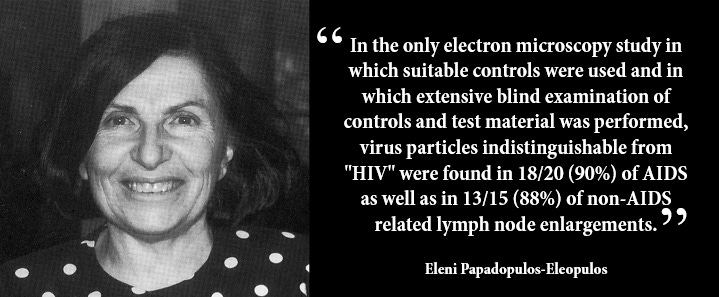
The Nature authors cited an electron microscopy study in which particles indistinguishable from those claimed to be HIV were observed in uninfected tissues. The researchers of that study emphasized that particle detection does not constitute proof of the presence of a virus, because such particles cannot be distinguished from naturally occurring structures.
“In the only EM study, either in vivo or in vitro, in which suitable controls were used and in which extensive blind examination of controls and test material was performed, virus particles indistinguishable from HIV were found in a variety of non-HIV associated reactive lymphadenopathies leading the authors to conclude: “The presence of such particles do not, by themselves indicate infection with HIV.”
In light of the non-specificity of the protein reactions (antibody-antigen) relied upon as evidence for HIV, a 1997 medical journal article argued that the evidence for the existence of HIV should be critically reevaluated.
“The demonstration of specific antibody/protein reactions is the fundamental assumption underlying proof of HIV isolation, proof of HIV infection, and the claim that HIV causes AIDS. However, because antibodies that react with the supposed ‘HIV’ proteins also arise in non‑HIV–infected animals and humans after allogeneic stimuli, and in mice and humans with autoimmune disorders … the evidence for HIV’s existence and its alleged causal role in AIDS must be reappraised.”
In 1990, for example, researchers reported that normal, healthy dogs—an animal considered to be incapable of being infected with HIV—exhibited reactions to “HIV proteins.”
“In a serological survey, using the immunoblotting technique, we found that substantial numbers of dog sera from both normal and diseased dogs, including dogs with neoplasia, reacted with one or more human immunodeficiency virus (HIV) recombinant proteins. A total of 144 dog sera were tested, and 72 (50%) of them reacted with one or more HIV recombinant structural proteins … Six dog sera reacted with at least the major core protein of HIV.”

Research over several decades has shown that the enzyme (reverse transcriptase) relied upon as evidence for HIV is widespread and is found in normal, uninfected cells. As virologist Harold Varmus noted in 1988:
“Although reverse transcription was first encountered in the retrovirus life cycle, it is hardly unique to retroviruses; it is now recognized as a widespread phenomenon in eukaryotic cells and viruses. Indeed, as much as 10% of the eukaryotic genome may be composed of products of reverse transcription.”
As early as 1971, Howard Temin, the discoverer of this enzyme, reported the detection in uninfected rat cells and remarked that the enzyme does not “necessarily represent oncogenic [retro] viruses.”
A year later, Temin detected it in “uninfected chicken embryos and cells in culture” and noted; “it is tempting to assume that this activity is related to normal cell function.”
The non-specific nature of this enzyme was clearly underscored by Varmus in 1987, who described it occuring “even in the uninfected cells of yeast, insects and mammals.”

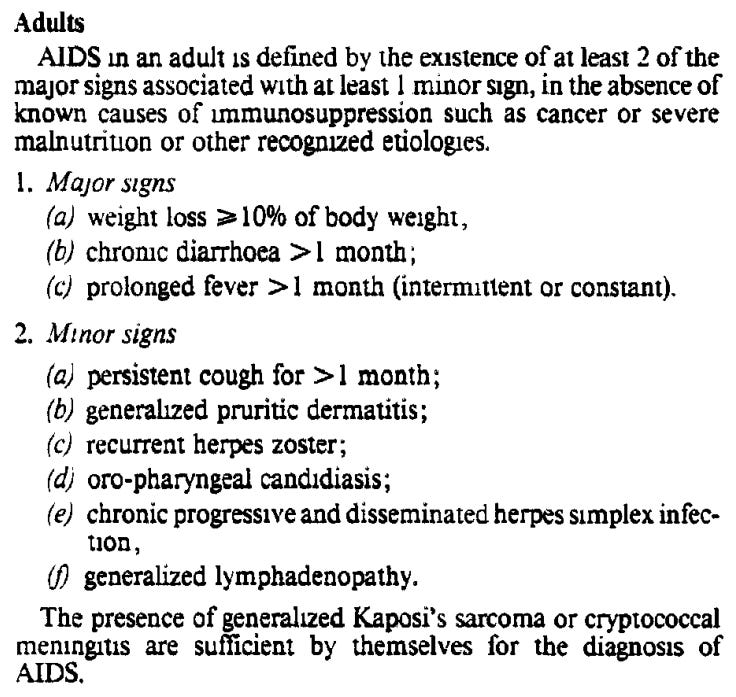
Medical authorities expanded the definition of AIDS beyond the first so-called “AIDS-defining” diseases.
In 1986, for instance, the World Health Organization introduced a diagnostic criterion for developing countries that classified anyone with a handful of common, non-specific symptoms—such as weight loss and diarrhea—as an AIDS patient.
A 1995 publication in the World Journal of Microbiology & Biotechnology argued that the diseases attributed to AIDS in Africa have long been present, affect both men and women equally, and result from factors unrelated to HIV.
“Both acquired immune deficiency (AID) and the symptoms and diseases which constitute the clinical syndrome (S) are of long standing in Africa, affect both sexes equally and are caused directly and indirectly by factors other than human immunodeficiency virus (HIV).”

Another widely used definition of AIDS relies upon a decline in a specific cell type (CD4). However, such a decrease is a non-specific phenomenon occurring in a wide range of unrelated conditions, as noted by a 2024 medical journal publication.
“Others have documented CD4 reduction in cases of malaria, viral, bacterial, and parasitic infections, psychological stress, burns, malnutrition, corticosteroid use, overexercising, pregnancy, and normal variation.”
The study that “represents the largest assessment of the relationship between surrogate outcomes and clinical events to date” reported that they “were unable to demonstrate a relationship between change in CD4 cell count or viral load and clinical events.”
In short, AIDS surrogate markers do not reflect actual health outcomes.
A 2004 publication argued that the scientific literature has consistently failed to show that AIDS is a contagious disease.
“The HIV theory predicted that HIV was sexually transmitted and therefore AIDS would spread throughout the heterosexual population. This has not occured. In fact data from the largest, longest, best designed and executed studies available conducted in the USA and Africa show that HIV is not heterosexually transmitted.”
For instance, a 1996 study followed 176 couples over several years in which one partner was HIV positive, and despite regularly sleeping together and engaging in unprotected intercourse, no instances of transmission occurred.
“No transmission occurred among the 25 percent of couples who did not use condoms consistently at their last follow-up nor among the 47 couples who intermittently practiced unsafe sex during the entire duration of follow-up.”

The Polio Hoax

The polio fraud began in the early 1900s with Simon Flexner of the Rockefeller Institute.
The Measles Hoax

The measles virus began as an imagined construct to explain why people get sick. A particle was not observed first and subsequently a virus theory was developed.
The Spanish Flu Hoax

The influenza pandemic at the end of World War 1 is claimed to have been a highly contagious disease.
The HIV/AIDS scandal serves as a crucial prototype for understanding the current COVID-19 operation and other manufactured health crises. It established a blueprint for using fear, manipulated statistics, and rigged testing methods to create the perception of a pandemic where none existed.
This model has been refined and amplified with each subsequent "health emergency," reaching its apex with the COVID-19 operation. The HIV/AIDS crisis demonstrated how a "disease" could be invented and sustained through media manipulation, rigged science, and financial incentives. It set the stage for future "pandemics" by establishing the methodology of using non-diagnostic tests to generate false positives, creating the illusion of widespread infection.
As early as 1949, Congressional bills which were introduced to abolish CDC because of the remarkable decline in "infectious disease" mortalities were twice won by impressive majorities. In 1994, Red Cross officer Paul Cummings told the San Francisco Chronicle that “The CDC increasingly needed a major epidemic” to justify its existence. The invention of the "AIDS Virus", and HIV/AIDS theory was salvation for American epidemic authorities.
James Curran, the Chief of the CDC’s Sexually Transmitted Diseases unit, described the desperation among the public health corps in the early 1980s: “There was double-digit inflation, very high unemployment, a rapid military buildup and a threat to decrease all domestic programs, and this led to workforce cuts at the Public Health Service, and particularly CDC.” They were hoping for a new plague. Polio was over. There were memos going around the agency saying, ‘We need to find the new plague’; ‘We need to find something to scare the American people so they will give us more money.’”
AIDS is not related to any "pathogen" but like other diseases is a by-product of biological systems being vaporized by toxic overload and multiple stressors. In the case of AIDS Inc. in the US and Europe, which became the raison d'etre for an embattled CDC and health industry, this biological meltdown was mainly due to massive drug use- amyl nitrite aka "poppers", cocaine, amphetamines, etc. in combination with severe and prolonged malnutrition and sleep deprivation.
The story was as follows- A deadly new virus is discovered. There's no treatment or cure. It's highly contagious. Everyone is a potential victim. The world is at risk from asymptomatic super spreaders. New clusters of “cases” are reported daily.
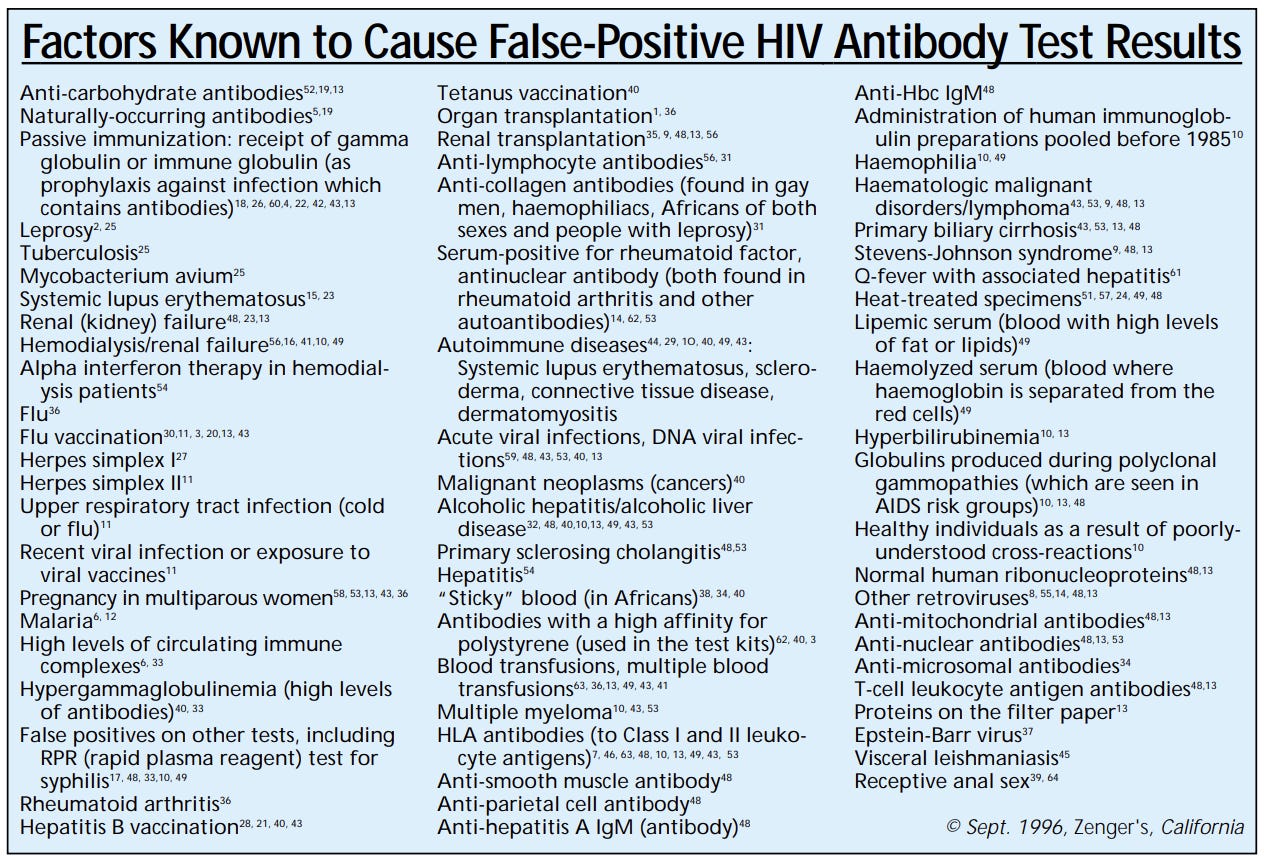
Everyone must get tested even though the tests are fraudulent. Positive antibody tests are called "infections" and "cases" even when the patient has no symptoms. Media hysteria kicks into high gear. Billions of dollars are authorized for fast track drug and vaccine research. Presumptive diagnoses are accompanied by exaggerated death statistics and falsified death certificates.
Sound familiar?
Is there anything in the medical regime that isn't a hoax? I think not.